Sacha Swiftbird
The Last JediSacha Swiftbird is an Antarian Ranger, former Podracer, and mech-tech whose practical ingenuity helps the resistance pursue the rescue of Thi Xon Yimmon. Her history is written both on her body and in the name she keeps: after a race crash forced her out of Podracing, she retained the alias Swiftbird in her new life among the Rangers. At Kantaros Station, she proves that her contribution is not confined to machinery; she can improvise a cover, manipulate surveillance, and fight when the plan turns dangerous.
Identity and Background
Sacha works as an engineer with the Rangers on Toprawa. Swiftbird was her Podracing alias, and she continued using it after joining the Rangers, carrying the identity of her former career into a different kind of work. The story gives no account of her full transition between those lives, but it makes clear that the change did not erase the name or the skills associated with it.
Her racing career ended after a horrific accident. Sacha hints that the crash was not an accident at all, but revenge by a driver who had lost a race. The injury left her with a cybernetic implant in place of her left eye and silvery scarring across both eyelids. She normally keeps the damage hidden beneath a thick lock of black hair. Jax Pavan notices the scars and thinks of Laranth Tarak, whose own scar tissue recalls Order 66 and Flame Night; the resemblance makes it difficult for him to meet Sacha’s pale-gray gaze. The narrative establishes an echo between their visible injuries without treating their histories as identical.
Sacha is introduced during work on Jax’s Delta-7 Aethersprite. She offers to modify the craft to make room for Den Dhur, but Jax declines: he wants stealth, speed, and strength without advertising that he is a Jedi, and considers the single-pilot craft suitable as it is. Sacha accepts his decision rather than pressing the modification. Her readiness to propose a useful change, and to leave the choice to its pilot, establishes her as technically capable and direct.
A Ranger in the Resistance Network
Sacha is one of a small number of people who know about the Toprawa operation to move Yimmon. When Tuden Sal asks whether a contact on Toprawa might have betrayed the group, Jax names Degan Cor, Aren Folee, and Sacha as people who knew of the move. The question makes the operation’s dependence on trusted contacts explicit, but the evidence does not identify Sacha as the suspected traitor. Jax instead insists that the resistance must trust its allies if it is to recover Yimmon, while remaining alert to the possibility of betrayal.
The crisis also changes how the resistance thinks about leadership. In the aftermath of Yimmon’s capture, the group decides against placing all responsibility in one person’s hands: it will have multiple leaders, with distinct areas of responsibility, autonomy, and overlap. Sacha’s presence among the operation’s trusted Toprawa contacts places her within a network whose strength depends on cooperation rather than a single chain of command. The account does not assign her a formal leadership post, but her later technical and operational work shows how such a network can draw on specialized skills.
When the Laranth/Corsair returns to Toprawa from Mandalore, Sacha is among the welcoming party at Mountain Home, along with Degan Cor and Geri. Jax steps off the ramp visibly containing turmoil, and Degan recognizes that something has gone wrong. Sacha takes responsibility for guiding him through the base while Degan summons Aren Folee, then away in Big Woolly. Her first response is practical encouragement: knowing where Yimmon is being held is already a victory, she tells Jax, and the resistance can assemble a team to retrieve him. Jax counters that Kantaros Station is a closed system; Sacha answers by treating that difficulty as a problem to be solved, not a reason to give up.
Technical Skill and Support for the Rescue
Sacha’s advice about penetrating Kantaros Station reveals a method based on selective interference rather than conspicuous destruction. Surveillance cameras, she explains, can be made to hiccup through carefully applied energy pulses. Altering only one or two cameras at a time makes the disruption harder to detect. Alternatively, a camera can be made to register a false image: an empty corridor, someone who belongs there, or intruders in the wrong location. That last deception requires careful planning. Her approach is incremental and controlled, suited to a closed facility where a sweeping attack would draw attention.
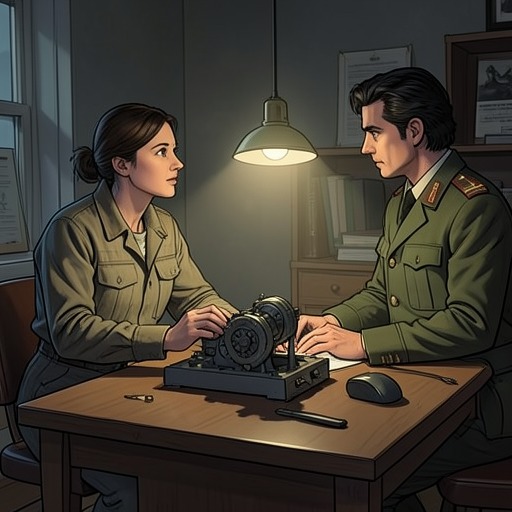
She later puts that expertise into a compact device: a sensor recursor, a thin rectangle about as long as her index finger, equipped with a touch pad and a tiny video display. The device gives physical form to the approach she described. Rather than relying on Jax to handle every obstacle with the Force, Sacha intends to manipulate the cameras herself. That distinction matters to the rescue plan: her technical work offers a way into the facility that does not depend on the Jedi’s presence or on openly fighting the station’s guards.
Sacha also gives Jax support that is personal without becoming sentimental. She brings him a cup of shig while the group discusses how they might move through the station, then sits beside him as she explains her camera tactics. Her reassurance at Mountain Home and her contribution to the planning are of a piece: she acknowledges the danger but keeps the discussion oriented toward actionable possibilities.
Disguise, Deception, and the Kantaros Operation
At Kantaros Station, Sacha’s improvisation extends beyond machinery. She enters the stationmaster’s office looking hard and piratical, presenting the group’s wares, which they had learned on Mandalore were in demand. The stationmaster, Cleben, is drawn to her as the apparent captain. When he asks whether she inherited the ship, she smoothly explains that the former owner took the vessel but left its identification codes. She supplies the name Rancor’s Heart as the name he had wanted for it, and adds that captains do not choose their ships’ names under the Vigo she serves, Xizor.
The cover story turns a potential liability—the mismatch between the ship’s identity and its altered appearance—into part of the explanation. Den Dhur is preparing to improvise a lie when Sacha answers first, maintaining her composure and controlling the exchange. Her performance combines the goods they have brought, her assumed status as Captain Swiftbird, and a plausible account of the ship’s codes. She is not merely accompanying the infiltration: she is actively managing the social access on which it depends.
Confrontation and Significance
The operation becomes violent when Probus Tesla, an Inquisitor, reacts to a disguised stormtrooper and uses the Force to wrench the rifle away, lift her, and throw her against a lift wall. The woman is Sacha. The attack draws a surge of fear and rage from the corridor, followed by Jax Pavan’s arrival with his lightsaber. Tesla is subsequently dead, and Sacha stands over him still wearing the stormtrooper armor, a Sith lightsaber in her hands. She deactivates the blade and looks to Jax; together they move to hide Tesla’s body.
This reversal gathers her different capacities into one decisive moment. The mech-tech who had planned to misdirect cameras has also taken on the appearance of a stormtrooper; when Tesla attacks, she survives the assault and becomes the agent of his death. The account does not spell out how she obtained the Sith lightsaber or narrate every movement of the fight, so her victory is presented through its result rather than a detailed choreography. What is clear is that she is not simply rescued by Jax: she is standing over the dead Inquisitor before he asks for her help.
Sacha’s role in the rescue plot therefore joins technical competence to independent action. Her cybernetic eye and scars recall a past shaped by injury and betrayal, while her work at Kantaros shows a person able to adapt to new circumstances without being reduced to them. She carries the alias of a life that ended abruptly, but uses what she has learned—mechanical knowledge, nerve, and performance—in service of a different struggle.